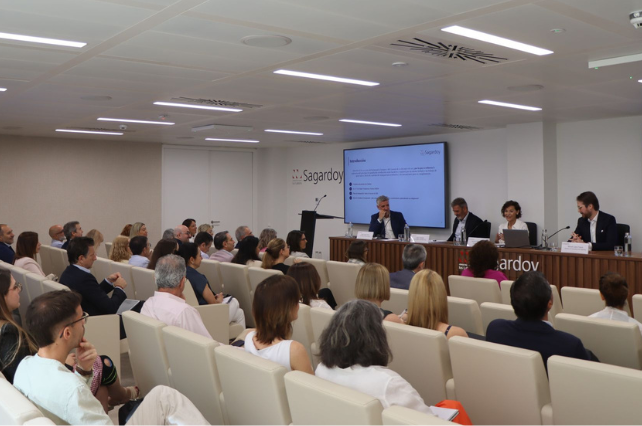
On 25 February, Sagardoy hosted an international seminar on current labour and employment law at its Madrid headquarters, in collaboration with Ius Laboris, the world’s leading global alliance of employment law firms, of which Sagardoy is a founding member.
The event brought together professionals from Labour Relations, Human Resources and legal specialists from various jurisdictions to analyse the key issues that will shape the international employment law agenda in the coming years.
The seminar was opened by Iñigo Sagardoy de Simón, Chairman of the firm, who highlighted the need to address the rapid transformation of the labour market from a comparative perspective and within a coordinated global framework.
Throughout the three expert panels, speakers examined central themes such as the impact of artificial intelligence on labour relations, the legal reforms expected to take effect in 2026, and the intensifying global competition for talent. The discussion also explored the increasingly significant role of special tax regimes for expatriates as strategic tools for attracting and retaining highly qualified professionals in a highly competitive international environment.
The first panel, moderated by Sagardoy partners Román Gil Alburquerque and Javier Alonso de Armiño, brought together experts from Denmark, Germany, Italy, Portugal and the United Kingdom to assess how AI is reshaping workplace dynamics.
Speakers —Sara Baldus (Norrbom Vinding), Dr Thomas Gerdom (KLIEMT), Donatella Cungi (Toffoletto De Luca Tamajo), Inês Oom de Sacadura (pbbr) and Toni Lorenzo (Lewis Silkin)— examined the scope of the new EU Artificial Intelligence Regulation and its implications for employment relations. They discussed issues such as algorithmic supervision, automated recruitment processes, and the increasing transparency and traceability requirements applied to workplace technologies. The panel also reviewed recent legal developments adopted by various European countries and the United Kingdom to align with the new regulatory framework.

The second panel, moderated by Gisella Alvarado Caycho, Associate at Sagardoy, focused on the legislative changes that will shape individual employment rights in 2026.
Experts from Brazil, Finland, France, Mexico, Slovakia, the Netherlands and the United Kingdom participated: Flavia Azevedo (Veirano), Nana Karanen (Dittmar & Indrenius), Stéphanie Tondreau (Capstan), Luis A. Álvarez, Jan Janak (Nitschneider & Partners), Lusi Álvarez (Basham Ringe y Correa), Renske van Herpen (Bronsgeest Deur Advocaten) and Gemma Woodhead (Lewis Silkin).
Topics included fixed‑term contracts, outsourcing, remote working, equality and the gender pay gap, holiday entitlements, work–life balance rights and termination of employment. The comparative analysis enabled the identification of cross‑jurisdictional trends and shared challenges.

The final panel, moderated by Sylvie Dumortier (Claeys & Engels), addressed the growing global competition for talent and how different countries are responding through special tax regimes for expatriate professionals. The panel featured experts from Belgium, Italy, Portugal, Spain and the United Kingdom: Diego Paciello (Toffoletto De Luca Tamajo e Soci), Inês Oom de Sacadura (pbbr), Luis Alcaraz (Sagardoy Legal & Expat) and Philip Swinburn (Lewis Silkin).
Speakers analysed how these tax frameworks can enhance compensation packages, facilitate international mobility and strengthen talent‑acquisition strategies, highlighting key trends and emerging opportunities for global employers.

Following the panel discussions, the event concluded with one‑to‑one meetings between speakers and participants, followed by a networking cocktail that encouraged dialogue and the exchange of experiences.
The seminar underscored the commitment of Sagardoy and Ius Laboris to the dissemination and comparative analysis of international employment law, reinforcing their position as a leading alliance in global labour‑law advisory services.